What CRC Media Should You Use?
Starting recipes for color remediation media, and what to change when color, pesticides or heavy metals persist.

Start with the simplest recipe that solves your problem, then add only what the problem calls for.
Step 1. What are you remediating?
| Problem | Starting recipe | Parts by volume |
|---|---|---|
| Chlorophyll and color only | Recipe A | 1 part Silica 60A (silica gel) 1 part T-5 Bentonite Clay |
| Color plus pesticides or heavy metals | Recipe B | 3 parts Silica 60A (silica gel) 3 parts T-5 Bentonite Clay 1 part T-41 Activated Bleaching Clay |
Step 2. Still having issues?
- Color still bad? Refresh the media, add more media, or both.
- Pesticides or heavy metals showing up? Move to Recipe B, or step up to the follow-up recipes below.
| Follow-up recipe | Parts by volume |
|---|---|
| Follow-up A | 3 parts Silica 60A 3 parts T-5 Bentonite Clay 1 part T-41 Activated Bleaching Clay |
| Follow-up B | 3 parts Silica 60A 3 parts T-5 Bentonite Clay 3 parts T-41 Activated Bleaching Clay 1 part MagSil PR |
Filters under the media
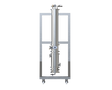
Media only works if it stays in the column. In a color remediation column, stack sintered tri-clamp filter discs of 10, 5, 2 and 1 µm, decreasing in rating in the direction of flow, with every disc dull side toward the incoming flow. A paper filter above the first disc is optional and keeps fine media from loading the disc. See Sintered Filter Technical Specifications for ratings and cleaning.
Remediation removes what you do not want. It does not separate one cannabinoid from another. If that is the goal, read Remediation vs. Chromatography.
Sources. N.B. Oler Technical Brief 10b, What CRC Media Should You Use, Rev. 2026.1 (2026 Training Binder). Media names as supplied: Silica 60A (silica gel), T-5 Bentonite Clay, T-41 Activated Bleaching Clay, MagSil PR.
PARTS THIS ARTICLE COVERS
Most parts listed here are in stock in Bend and usually ship the same day when ordered by 1 PM PT. Each product page shows its own lead time.