Why We Put Brass Nuts on Stainless Bolts
Share
If you have ever run a stainless nut down a stainless bolt and had it lock up halfway, you have met galling. It is one of the most common problems we see on extraction equipment.
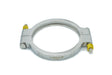
It is why the bolted clamps we sell pair a 304 stainless bolt with a brass nut, and why the relief valves on our systems have brass bodies.
What galling is
Stainless stays clean because it carries a very thin chromium oxide film. That film also keeps two stainless parts from sticking to each other. When threads slide under load, the film wipes off at the high spots. Two clean surfaces of the same alloy at the same hardness, pressed together hard, start to cold weld. Small pieces of metal tear out of one thread and pile up on the other, friction climbs, and the nut locks. Once it seizes, it usually comes off by cutting it or by tearing the threads out.
Speed, heat and dirt make it worse. A nut spun down fast with a drill or an impact, or grit in the threads, raises the odds every time.
Why brass
Galling is worst between two metals that are alike. Brass is a copper alloy and much softer than 304, so it does not cold weld to stainless the way stainless does to itself. The softer brass threads conform to the bolt instead of tearing it up.
That also decides which part wears. The nut is the cheap part and it is designed to wear first. Our engineering report lists the bolt set as 304 stainless bolts with brass nuts, and we never offer a stainless nut on these clamps.
Treat the nut as a consumable
Our service schedule replaces brass nuts every 6 months and bolts every 12 months, regardless of condition. Each time a nut comes off and goes back on, the softer threads give up a little. A nut that has been on and off for six months has done its job. Replacing one on schedule costs far less than cutting a seized bolt off a clamp in the middle of a run.
Nobody publishes a reuse count for brass nuts on tri-clamp hardware, so we will not invent one. The direction is clear: the threads get softer with each cycle, so replace on a schedule and do not stretch it.
Torque is set by the gasket, not the clamp: 30 in-lbs with elastomer gaskets such as Buna-N, Viton and silicone, and 50 in-lbs with rigid gaskets such as solid PTFE. Over-torquing strips threads, and stripped threads are a common failure point.
Which hardware fits which clamp
There are two families, and a wrench tells them apart. A 5/8 inch nut means the 3/8-16 sets. A 3/4 inch nut means the M12 hardware for our heavy duty 6 inch clamp.
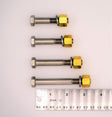
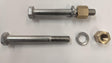
- The 3/8-16 sets come with a brass nut and a split washer in four bolt lengths: 2 inch for the 3/4 inch clamp, 2.25 inch for the 1.5 inch clamp, 2.75 inch for the 2, 2.5 and 3 inch clamps, and 3.25 inch for the 4 inch clamp. Measure the shaft from under the head to the end of the thread.
- The heavy duty 6 inch clamp takes M12 x 1.75 hardware, and it takes two sets per clamp. M12 is 0.472 inch and a 1/2-13 bolt is 0.500 inch, so a hardware store half inch bolt will not thread into the nut, even though these clamps are widely called half inch bolt clamps.
- The M12 brass nut is a deep nut, 0.66 inch tall against 0.394 inch for a standard M12 nut. That is about 1.7 times as much thread, which spreads the clamp load over more of the softer brass.
If you have stainless on stainless somewhere
Run it down slowly by hand, keep the threads clean, and use a thread lubricant that is compatible with your solvent and process. If a stainless nut starts to bind, stop and back it off. Forcing it is how it seizes.
The same logic on relief valves
A stainless valve in a stainless NPT port is the same setup as a stainless nut on a stainless bolt, and tapered pipe threads are under load the whole way in. Relief valves get replaced often, so every replacement is a valve threaded out of and back into a vessel port. Our cryogenic relief valves have brass bodies (ASTM B16 brass) with stainless springs, so the valve is the soft side of the joint and the stainless port on the vessel stays clean. How often to replace them is in How Often to Replace a Relief Valve.
Bolt sets, brass nuts and split washers are sold individually and as complete sets, in both thread families. Current pricing is on the product pages below.