
Choosing Tri-Clamp Gasket Material: Buna-N, Viton and PTFE
Share
Chemistry decides which gaskets can work. Temperature decides which one will. On a cold line, that is PTFE.
At a glance
| Buna-N (nitrile) | Viton (FKM) | PTFE | |
|---|---|---|---|
| Temperature range | -30 to 250°F (-34 to 121°C) |
-15 to 400°F (-26 to 204°C) |
-400 to 500°F (-240 to 260°C) |
| Butane, propane, heptane, hexane | A | A | A |
| Ethanol | C | B | A |
| Isopropyl alcohol | A | A | A |
| Methanol | B | D | A |
| Acetone | D | D | A |
| Price | Low | Moderate to high | High |
| Service life | Moderate | Long | Long |
| Installation | Easy | Easy | Seat carefully. Cold flows under clamp load |
| Best for | General purpose, room temperature hydrocarbon and water service | Hot service and broader chemistry | Cold lines, any solvent, extreme temperatures |
Temperature limits are standard compounds (Parker N0674-70, V0747-75). Low temperature Buna-N and Viton compounds reach about -55 to -70°F (-48 to -57°C), still short of hydrocarbon recovery temperatures. Chemical ratings: A excellent, B good, C fair, D do not use. Room temperature, conservative value printed.
Buna-N
Nitrile rubber. Economical, easy to install and strongly resistant to oils, water and light hydrocarbons at room temperature. Only fair with ethanol, and attacked by acetone and ketones. The right gasket for general purpose, room temperature joints. Shop Buna-N gaskets.
Viton
Fluoroelastomer. Built for heat, to 400°F (204°C), resists compression set so it keeps sealing under load, and tolerates a broader range of chemicals. Do not clean standard Viton with methanol, which swells it badly. Isopropyl alcohol is fine. Shop Viton gaskets.
PTFE
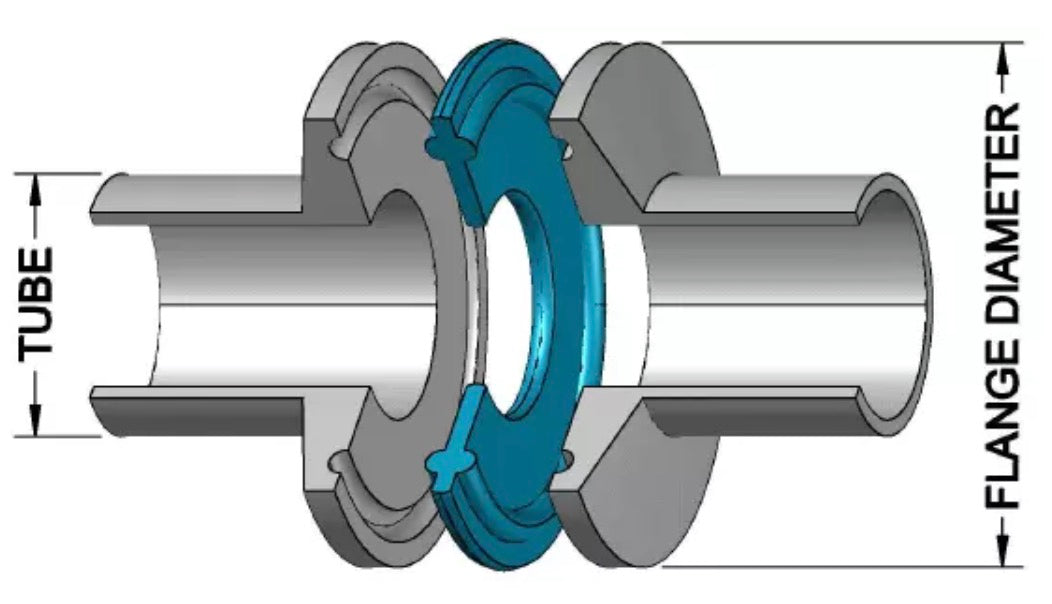
Chemically inert and rated from cryogenic to 500°F (260°C). It costs the most and needs careful seating, because PTFE creeps under clamp load. A PTFE envelope gasket, a PTFE face over an elastomer core, gives you PTFE's chemistry with better sealing. Shop PTFE envelope gaskets.
Hydrocarbon recovery runs to -65°C (-85°F). Buna-N and Viton are below their rated limits there and can shrink, harden and leak on the next warm cycle. Use PTFE on every joint that sees chiller or LCO2 temperatures.
Full compatibility matrix and temperature data for every common seal material: REF-CM-01 Chemical Compatibility. Clamp pressure limits by size: REF-CL-01 Tri-Clamp Pressure Ratings.
Sources. N.B. Oler REF-CM-01 Chemical Compatibility, Rev. 2026.1: Parker Hannifin O-Ring Handbook ORD 5700 and compound data ORD 5712; Chemours Viton Selection Guide; Trelleborg Materials Chemical Compatibility Guide; Industrial Specialties Mfg. chemical compatibility chart.