Cryogenic Relief Valve Selection: Set Pressure, Seal Material, and When ASME Is Required
Four relief valves protect an N.B. Oler hydrocarbon system, and they are not interchangeable. Pick each one by four questions: the pressure it must open at, how cold and how hot it gets, whether the vessel falls inside the ASME code, and how much vapor it has to move.

Same set pressure is not the same valve.
REF-PRV-01 · Source: 3P Certz ECR-250902-R0 · Revision 2026.1 · Issued 25 September 2026
The four valves
| Valve | Code stamp | Port | Seal | Temperature | Rated flow | Where it goes |
|---|---|---|---|---|---|---|
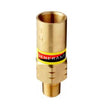
| Generant brass CRV, 1/4" | None | 1/4" MNPT | Fluorosilicone below 50 psi, PCTFE 50 psi and up | PCTFE: -320 to 165°F (-196 to 74°C) Fluorosilicone: -85 to 350°F (-65 to 176°C) |
117 SCFM at 250 psi | Vessels 6" ID and smaller (material columns, molecular sieve), chiller line and jacket inlets, CO2 supply |
| Generant brass CRV, 1/2" | None | 1/2" MNPT | Same as 1/4" | Same as 1/4" | 57 SCFM at 100 psi | Jackets and any 1/2" port. Same 0.250" (6.35 mm) orifice as the 1/4" |
| Generant RVA, 1/2" | ASME UV and National Board | 1/2" MNPT | Carbon filled PTFE | -320 to 200°F (-196 to 93°C) | 0.062 in² orifice, Kd 0.667 | Any 1/2" port where the inspector, AHJ or insurer asks for a stamped relief. Gas service only |
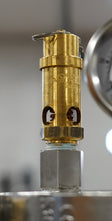
| Conrader SRV530 | ASME and National Board | 1/2" MNPT | Viton seat | -30 to 400°F (-34 to 204°C) | 970 SCFM at 250 psi | Solvent tank, recovery vessel and the 8" color remediation column. SRV530 on the two big vessels, the smaller SRV390 (449 SCFM) on the CRC |
Every one of these is factory set and sealed. None is adjusted in the field. Order the set pressure for the location, and when replacing a valve, match the pressure stamped on the one coming off.
1. Set pressure
A relief valve starts to open at the pressure rating of what it protects, never above it. NFPA 58, section 5.9.2.5, requires the start to leak setting on an ASME container to be 100 percent of the container's pressure rating. Every process vessel on our systems is rated 250 psi (1,724 kPa), so every process vessel relief is set at 250 psi. The jackets are designed for 100 psi (689 kPa), so jacket reliefs are set at 100 psi.
| Location | Set pressure | Valve |
|---|---|---|
| Solvent tank, vapor space | 250 psi | Conrader SRV530 |
| Recovery (collection) vessel | 250 psi | Conrader SRV530 |
| Color remediation column (8") | 250 psi | Conrader SRV390 |
| Material columns | 250 psi | Brass CRV, 1/4" |
| Molecular sieve | 250 psi | Brass CRV, 1/4" |
| Solvent vessel and column jackets | 100 psi | Brass CRV, 1/2" |
| Chiller line and jacket inlets | 22 psi | Brass CRV |
| CO2 supply | 350 psi | Brass CRV |
Vessel valves from ECR-250902-R0. Jacket, chiller inlet and CO2 settings from 3P Certz Certificate of Conformance 3PC0930 for a 20 LB system. Manifold ratings vary by build, so the build sheet for your system governs.
- Full flow comes at 110 percent of set. A 250 psi valve is fully open by 275 psi. Generant valves reseat at 90 percent of set (85 percent for PCTFE seals set below 100 psi) and are unaffected by back pressure up to 10 percent.
- Set tolerance. Brass CRV: plus or minus 5 percent at or below 28.9 psi, plus or minus 1.45 psi from 29.0 to 48.3 psi, plus or minus 3 percent at 48.4 psi and above (EN ISO 4126-1).
- Never substitute a higher setting because it is the one on the shelf. A 350 psi valve on a 250 psi vessel protects nothing.
2. Seal material and temperature
The seal decides how cold and how hot a valve can go, and on the brass CRV the seal is set by the pressure you order.
- The CRV seal changes at 50 psi. From 10 to 49 psi Generant fits Fluorosilicone, good from -85 to 350°F (-65 to 176°C). From 50 psi up it fits PCTFE, good from -320 to 165°F (-196 to 74°C). So the 22 psi valve on a chiller inlet is not a -320°F valve, and a 250 psi valve is not a hot valve. For genuinely cryogenic service, use 50 psi or higher.
- PCTFE caps the hot side at 165°F (74°C). In ECR-250902-R0 the brass CRV is the component that sets the maximum allowable temperature of every chamber it is fitted to: the material columns, the molecular sieve and the solvent vessel jacket. Keep jacket water on those chambers below 165°F.
- The Conrader is not a cryogenic valve. Its rating is -30 to 400°F (-34 to 204°C), and the ECR names it as the component that limits the minimum allowable temperature of the solvent vessel, the recovery vessel and the color remediation column. It works there because it sits in the vapor space at the top of the vessel, which runs far warmer than the jacketed wall. Do not move one to a port that sees liquid or chiller cold.
- The RVA is rated for gas service only. On cryogenic media Generant requires vapor barrier piping upstream of the valve, commonly called a candy cane, so the seat sees gas rather than liquid. Plumbed straight into liquid it will not perform to its data sheet.
- Every Generant valve ships cleaned and packaged for oxygen service (CGA G-4.1) and suits liquid CO2 and nitrogen, provided the seal is right for the temperature.
3. When ASME is required
ASME Section VIII, Division 1, paragraph U-1, puts a vessel inside the code when its inside diameter is greater than 6 inches (152 mm) and its pressure is greater than 15 psi (103 kPa). Below either line the vessel is outside the code's scope, unless the local authority says otherwise. That single test sorts every chamber on the system:
| Vessel | Inside diameter | Design pressure | ASME U stamp required? | Relief fitted |
|---|---|---|---|---|
| Solvent vessel | 12.08 in (307 mm) | 250 psi | Yes | Conrader SRV530 |
| Recovery (collection) vessel | 12.38 in (314 mm) | 250 psi | Yes | Conrader SRV530 |
| Color remediation column (8") | 7.78 in (198 mm) | 250 psi | Yes | Conrader SRV390 |
| Material column | 5.75 in (146 mm) | 250 psi | No, ID 6 in or less | Brass CRV, 1/4" |
| Molecular sieve | 5.72 in (145 mm) | 250 psi | No, ID 6 in or less | Brass CRV, 1/4" |
Table from ECR-250902-R0, 40 LB system.
- A code vessel gets a coded relief. On the three chambers inside the code, the ECR fits Conrader valves carrying ASME and National Board marks, sized to the vessel under NFPA 58.
- A vessel 6 inches and under takes the brass CRV. The material columns and the molecular sieve are outside the code, so the ECR sizes their reliefs under CGA S-1.1 and fits the uncoded 1/4" CRV.
- The state, the AHJ or the insurer can require more. New Jersey, for example, requires every unfired vessel over 6 inches ID and 15 psi to carry a valid U stamp. When an inspector asks for a stamped relief on a port that normally takes a brass CRV, such as a jacket, the Generant RVA, 1/2" is the stamped valve for that job. The brass CRV will not satisfy an inspector who asks for a stamp, however well it works.
- The stamp is on the valve. An RVA arrives with the ASME UV and National Board stamps on its body. NFPA 58, section 5.9.2.9, also requires every relief on an ASME container to be marked with its start to leak pressure, its rated capacity in SCFM of air, and the maker's name and catalog number.
4. Flow
Set pressure says when a valve opens. Flow says whether it can keep up. For the chambers inside the code, NFPA 58, section 5.9.2.6, sizes the relief from the vessel's outside surface area, the area a fire would heat:
F = 53.632 × A0.82 F in SCFM of air, A = outside surface area in ft²
| Chamber | Outside surface | Sizing rule | Required | Valve fitted | Rated | Margin |
|---|---|---|---|---|---|---|
| Solvent vessel | 2,317 in² (16.1 ft²) | NFPA 58 | 523.4 SCFM | Conrader SRV530 | 970 SCFM | 1.85x |
| Recovery vessel | 2,478 in² (17.2 ft²) | NFPA 58 | 553.0 SCFM | Conrader SRV530 | 970 SCFM | 1.75x |
| Color remediation column | 1,641 in² (11.4 ft²) | NFPA 58 | 394.4 SCFM | Conrader SRV390 | 449 SCFM | 1.14x |
| Material column | 1,113 in² | CGA S-1.1 | 42.4 SCFM | Brass CRV, 1/4" | 117 SCFM | 2.76x |
| Molecular sieve | 566 in² | CGA S-1.1 | 20.5 SCFM | Brass CRV, 1/4" | 117 SCFM | 5.71x |
Required and rated flows from ECR-250902-R0. Margin is rated divided by required. We rechecked the three NFPA 58 results from the report's surface areas and they reproduce exactly.
- A 1/2" CRV does not flow more than a 1/4". Both use the same 0.250" (6.35 mm) orifice. Buy the 1/2" because the port is 1/2", and do not adapt a 1/4" valve up to fit a 1/2" port.
- Same pressure is not the same valve. The solvent vessel needs 523 SCFM. A brass CRV at 250 psi moves 117. Both open at 250 psi, and only one of them protects the tank.
- One large valve or two small ones, never one small one. Mount the SRV530 off the 3/4" top cap connection with a tee; a 3/8" port will not pass the flow. Where no 3/4" connection exists, two SRV390 on two 3/8" ports give 898 SCFM, enough for either large vessel. A single SRV390 at 449 SCFM falls short of both.
The one rule to remember
A relief valve is chosen by pressure, temperature, code and flow. Matching the number stamped on it is only the first of the four.
Installation rules
- No shutoff valve between a relief and its vessel (NFPA 58, section 5.9.2.10), unless it is an approved relief manifold.
- The recovery vessel and color remediation column jackets carry no relief valve, by design. They are heated jackets on hot water only, fed by a Sterling or Mokon hot water unit, and that water flows at 30 psi maximum. The ECR calculates those jackets at 212 psi and 372 psi, far above anything the water side can reach. The hot water unit carries its own built-in relief, so the jacket must always stay in open communication with it. Never valve a heated jacket off at both ends.
- RVA on cryogenic service: candy cane upstream, so the valve sees vapor.
- Point the discharge somewhere safe and keep the outlet clear. Trash on the seat is the usual reason a relief stops resealing.
Replacement and spares
| What the valve sees | Replace every | Typical valve |
|---|---|---|
| Lifts often, you have heard it vent | 3 months | Brass CRV on a chiller inlet or column |
| Sees cold cycling and discolors | 6 months | Brass CRV on a jacket or column |
| Rarely cold, should never lift | 12 months | Conrader SRV530 or RVA on a large vessel |
Replace on what the valve actually sees, not on the calendar alone. Discoloration means cold cycling. A valve you have heard vent this month is a three month valve, and any ASME relief that has lifted gets looked at now, not at its next interval.
| Set pressure | 22 psi | 100 psi | 200 psi | 250 psi | 350 psi |
|---|---|---|---|---|---|
| Keep on the shelf | 3 + 1 spare | 1 + 1 | 1 + 1 | 6 + 1 | 2 + 1 |
Spares list from the N.B. Oler Hydrocarbon Operators Manual.
Quick pick
- Top of the solvent tank or recovery vessel: Conrader SRV530, 250 psi, teed off the 3/4" top cap.
- Color remediation column (8"): Conrader SRV390, 250 psi.
- Material column or molecular sieve (6" ID and under): Generant brass CRV, 1/4", 250 psi.
- Jacket: Generant brass CRV, 1/2", 100 psi. If an inspector asks for a stamp, Generant RVA, 1/2", 100 psi, with a candy cane on cryogenic service.
- Chiller line or jacket inlet: brass CRV, 22 psi. Fluorosilicone seal, rated to -85°F (-65°C).
- CO2 supply: brass CRV, 350 psi.
What to buy for this
 Cryogenic relief valve, 1/4 inchMaterial columns, molecular sieve, chiller and CO2 lines.
 Cryogenic relief valve, 1/2 inchJackets and any 1/2 inch port.
 Coded relief valve, 1/2 inchWhere the inspector, AHJ or insurer asks for a stamped relief.
 High flow relief valve, 250 psiSolvent tank and recovery vessel, set at 250 psi.
Need it built to your drawing? Request a quote
Sources: 3P Certz engineering report ECR-250902-R0 (40 LB hydrocarbon system, 2026): purchased components, pressure vessel summaries, NFPA 58 methodology and U stamp requirements. 3P Certz Certificate of Conformance 3PC0930 (20 LB system fitment). NFPA 58, sections 5.9.2.5, 5.9.2.6, 5.9.2.9 and 5.9.2.10. ASME BPVC Section VIII, Division 1, U-1. CGA S-1.1-2019. Generant brass CRV and RVA product literature and generant.com. N.B. Oler Hydrocarbon Operators Manual. Your system's own build sheet and certification report govern over this general guide. Questions about a specific port: call 541-330-6409, Monday to Thursday, 8 to 4 Pacific.
PARTS THIS ARTICLE COVERS
Most parts listed here are in stock in Bend and usually ship the same day when ordered by 1 PM PT. Each product page shows its own lead time.