


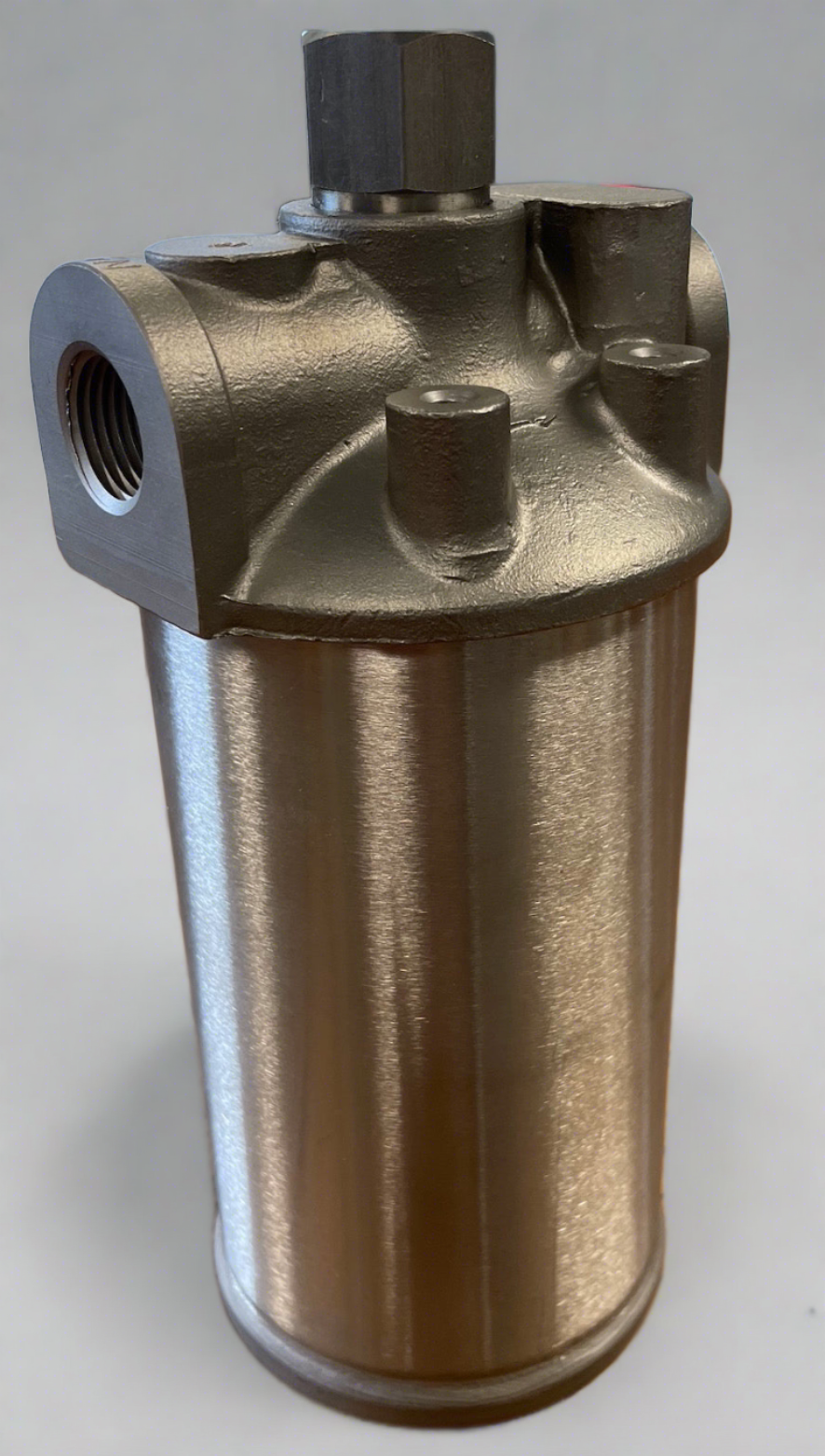
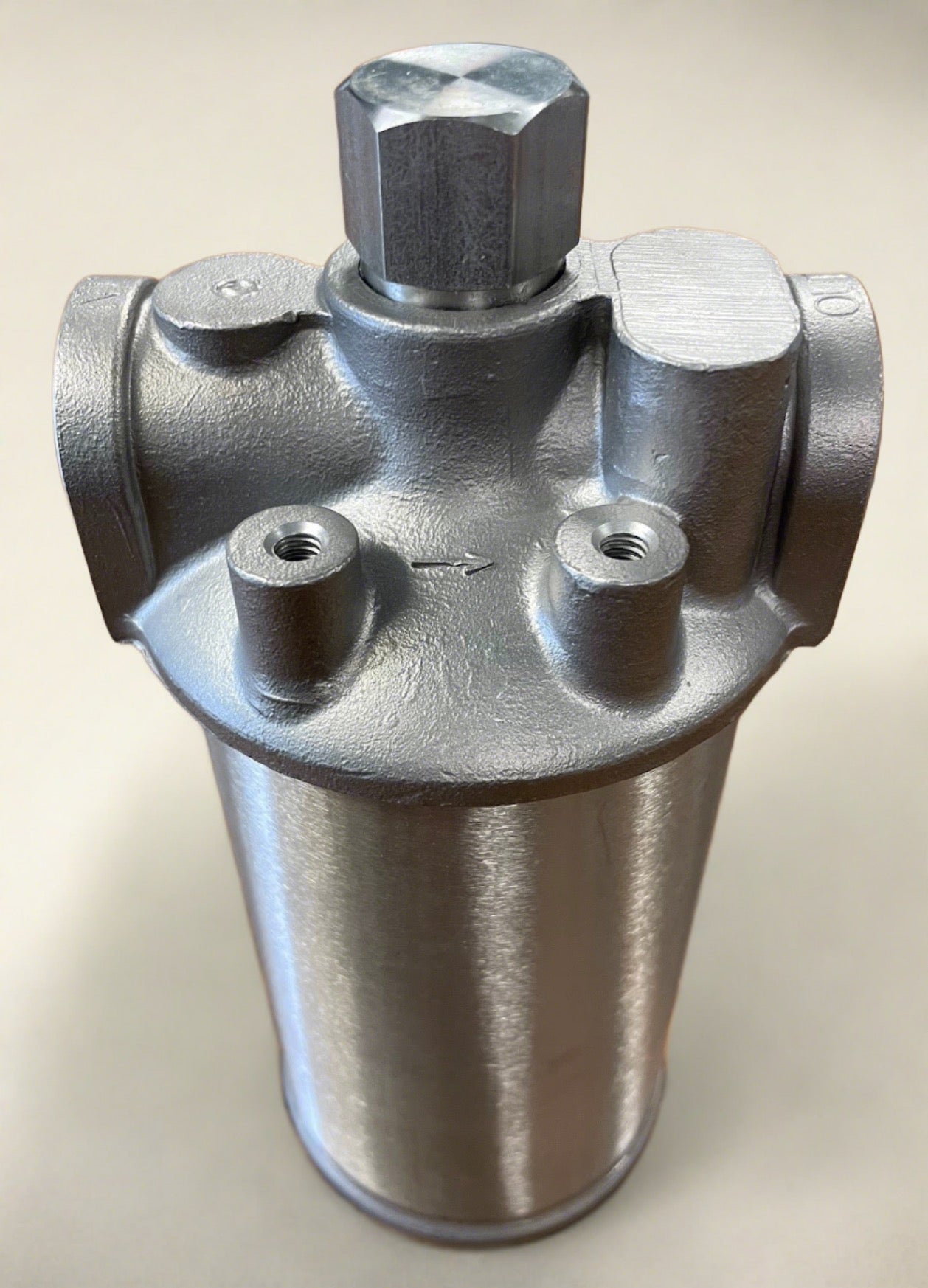


Inline Solvent Filter, 316L Stainless, 250 PSI, 1/2" FNPT
ABOUT THIS PART
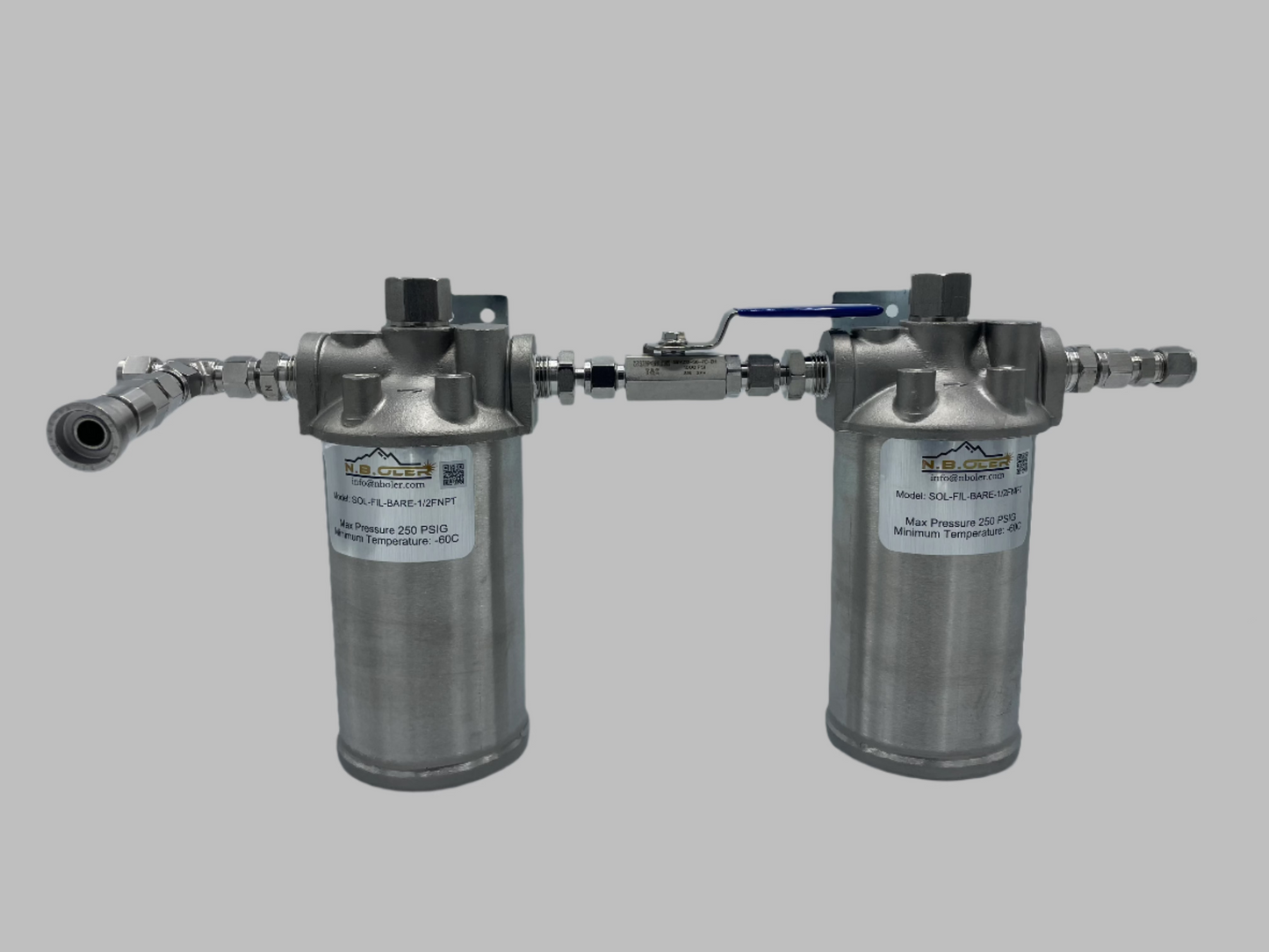
An inline pre filter for incoming solvent. It goes between the solvent tank and your extractor so dirty solvent never enters the machine. 316L stainless, Viton seals, 250 psi (17.2 bar), 400 F (204 C), 1/2 inch female NPT. $925 for the bare housing, $1,170 built out with Superlok ball valves and NPT to 3/8 inch compression adapters.
SPECIFICATIONS
| Type | Inline solvent pre filter, cartridge style |
|---|---|
| Position in process | Between the incoming solvent tank and your recovery tank or extractor, before solvent enters the system |
| Supplied by | N.B. Oler, Bend, Oregon. Built to our specifications |
| Material, head and internals and bowl | 316L stainless steel |
| Seals | Viton, standard |
| Maximum pressure | 250 psi (17.2 bar) |
| Maximum temperature | 400 F (204 C) |
| Ports | 1/2 in female NPT, inlet and outlet |
| Drain | 1/8 in NPT, stainless, in the bowl |
| Overall length | 8.875 in (225 mm) |
| Element bay length | 4.875 in (124 mm) |
| Change clearance | 1.5 in (38 mm) below the bowl to drop the element out |
| Measured flow | 100 lb of solvent in under four minutes on a 1 micron element, N.B. Oler field test at a customer site, roughly 25 to 30 lb per minute |
| Flow caveat | A finer element, a loaded element or colder solvent all reduce flow |
| Build 1, 1/2 in FNPT | Bare housing, thread in your own fittings. $925 |
| Build 2, NPT to 3/8 in compression with Superlok ball valves | Superlok ball valve each side, NPT to 3/8 in compression adapters, ready to tie into 3/8 in tube. $1,170 |
| Cartridges stocked | 1 micron spun polypropylene $65, activated carbon adsorbent $315. Sold separately |
| Cartridges available to order | Spun polypropylene 1 to 150 micron, pleated polypropylene 0.5 to 100 micron, pleated stainless 5 to 500 micron |
| Cartridge included | No. The housing ships empty |
| Material test reports | Not available on this housing |
| ASME | Not a pressure vessel, no stamp, none required at this size and pressure |
| Stock | 1 housing on the shelf |
| Lead time | Four to six weeks once the shelf unit is gone. Cartridges about one week |
| Not included | Cartridge, hose, solvent tank |
The two builds
| Build | What you get | Price |
|---|---|---|
| Bare housing | 1/2 in female NPT in and out. Thread in whatever you run. | $925 |
| With Superlok ball valves | A Superlok ball valve each side plus NPT to 3/8 in compression adapters, ready to tie into 3/8 in tube. | $1,170 |
The $245 difference is less than sourcing two Superlok valves and the adapters separately, and it lets you isolate the filter and change a cartridge mid transfer.
Specification
| Head, internals and bowl | 316L stainless steel |
| Seals | Viton, standard |
| Maximum pressure | 250 psi (17.2 bar) |
| Maximum temperature | 400 F (204 C) |
| Ports | 1/2 in female NPT, inlet and outlet |
| Drain | 1/8 in NPT stainless, in the bowl |
| Overall length | 8.875 in (225 mm) |
| Element bay | 4.875 in (124 mm) |
| Change clearance | 1.5 in (38 mm) below the bowl to drop the element out |
| Measured flow | 100 lb of solvent in under four minutes on a 1 micron element, roughly 25 to 30 lb per minute |
That flow figure is our own field measurement at a customer site, not a manufacturer rating. A finer element, a loaded element or colder solvent all slow it down. Material test reports are not available for this housing, so if your build requires certified material in this position, call before ordering.
Where it goes, and why
- Plumb it between the customer supplied solvent tank and your recovery tank or extractor, and run the transfer through it before the solvent ever sees your system.
- It is a pre filter on incoming solvent. It is not a post extraction filter and it is not a CRC column. You are protecting the machine and the run, not polishing the oil.
- Solvent arriving on a pallet is not always clean. Our own customers have found glycol carryover in incoming solvent, and more than one tore a system down for a full clean rather than lose another run.
- Since around 2021 extractors have chased Medusa stones, THCA diamonds that form clear then turn chalky within hours to a couple of days, along with fast crash and bar formations. The cause is not proven: Extraction Magazine states plainly that the exact cause has yet to be discovered, and Solvent Direct places it upstream at the refining stage.
- The one remedy in print is passing the solvent through molecular sieve, activated alumina or activated charcoal before use, with varying degrees of success. This housing is where you do that. The counterpoint is worth weighing too: some operators on Future4200 report that carbon treated material chalks more readily, not less.
- A cartridge is cheap. A contaminated batch of oil, or a system teardown, is not.
Cartridges
- The housing ships empty. Cartridges are sold separately on the Solvent Filter Cartridges page.
- 1 micron spun polypropylene, $65, for general particulate. Start here.
- Activated carbon adsorbent, $315, for chemical contamination. Reach for it when you suspect what came in the tank.
- Finer and coarser ratings can be ordered, from 0.5 micron pleated polypropylene up to 500 micron pleated stainless. Tell us the rating and we will quote it.
- For the molecular sieve leg of the same clean up, see 3A sieve beads for ethanol and 4A sieve beads for hydrocarbons.
Stock, lead time, and what it is not
- One housing on the shelf in Bend. After that it is a four to six week lead, because we order these in rather than stock them deep. Cartridges run about a week.
- Not a pressure vessel and not ASME stamped, because at this size and pressure it does not need to be.
- Not a CRC column, and it does not go between your extractor and your collection vessel.
- No cartridge and no hose included. It will not fix oil that is already contaminated. It filters what goes in, not what comes out.
- No electrical, so there is nothing to C1D1 rate. It is a passive stainless filter body.
| FITS | Fits inline between any solvent supply tank and any hydrocarbon extraction system, with 1/2 inch female NPT on the inlet and outlet, or NPT to 3/8 inch compression on the build with Superlok ball valves. Takes 4.875 inch elements in spun polypropylene, pleated polypropylene or pleated stainless, sold separately on our cartridge page. It does NOT fit a standard 10 inch water filter housing element, it is not a tri-clamp component, it is not a CRC column and it does not go between the extractor and the collection vessel. It is not covered by our ASME certification because it is not a pressure vessel, and material test reports are not available for it. |
|---|
▦ IN YOUR MANUAL
This part appears in the operator manual that ships with your system. The QR code there links to this page.
◈ REFERENCE FOR THIS PART
COMMON QUESTIONS
What does this filter actually do?
It filters solvent on the way in, before it reaches your extractor. You plumb it between the customer supplied solvent tank and your system and run the transfer through it, so contamination that arrived in the tank never gets into the machine.
Why would solvent from a gas supplier be dirty?
Because it sometimes is. Extractors have found particulate and chemical contamination in solvent bought from major suppliers, including glycol carryover, and have had to tear systems down and clean them out rather than keep running. Buying from a reputable supplier is not the same as verifying what arrived.
Does this stop Medusa stones?
Nobody can honestly promise that, because the cause has not been proven. Extraction Magazine states that the exact cause has yet to be discovered. Solvent Direct's write up puts the problem upstream in the refining supply chain. What is in print is that Solvent Direct reports some of these issues have been remedied by passing solvent through molecular sieve, activated alumina or activated charcoal before use, with varying degrees of success. This filter is where you run the activated charcoal leg of that. Worth knowing the counter argument too: some extractors report carbon processed material chalks more readily.
What is a Medusa stone?
A THCA diamond that forms clear and transparent and then turns chalky and opaque within hours to a couple of days. The same period since roughly 2021 brought reports of fast crash, diamonds nucleating the moment product leaves the extractor, and bar formations, crystals growing rectangular rather than faceted.
Is this a CRC column?
No. A CRC sits after extraction and treats the oil. This sits before extraction and treats the solvent. Different job, different position, different result.
What is it made of?
316L stainless steel head, internals and bowl, with Viton seals. It is not polypropylene and it is not plastic.
What pressure and temperature can it take?
250 psi (17.2 bar) and 400 F (204 C).
How fast will it move solvent?
We measured 100 lb of solvent through it in under four minutes on a customer's floor with a 1 micron element fitted, which is roughly 25 to 30 lb per minute. That is our own field number, not a manufacturer rating. Finer media, a loaded element or colder solvent will all slow it down.
What is the difference between the two builds?
The $925 build is the bare housing with 1/2 inch female NPT in and out. The $1,170 build adds a Superlok ball valve on each side and NPT to 3/8 inch compression adapters, so you can isolate the filter, change a cartridge mid transfer and tie straight into 3/8 inch tube. The $245 difference is less than buying two Superlok valves and the adapters separately.
Does it come with a cartridge?
No. The housing ships empty and cartridges are sold separately, so you pick the media that suits the job.
Which cartridge should I start with?
The 1 micron spun polypropylene at $65. Move to the activated carbon at $315 when you suspect chemical contamination rather than particulate, for example a drum you do not trust or a lot that behaved strangely.
Can I get a finer or coarser element?
Yes. Spun polypropylene runs 1 to 150 micron, pleated polypropylene 0.5 to 100 micron, and pleated stainless 5 to 500 micron. None are stocked, all can be ordered. Email info@nboler.com with the rating and media.
Can I get material test reports?
Not on this housing. MTRs are not available for it. If your build needs certified material in this position, call us before ordering and we will talk through alternatives.
Is it ASME certified?
No, and it does not need to be. It is not a pressure vessel at this size and pressure.
How do I drain it?
There is a 1/8 inch NPT stainless drain in the bowl, so you can pull the leg without breaking the line.
How much room do I need around it?
Overall length is 8.875 inches, and you need 1.5 inches of clearance below the bowl to drop the element out. Plan for both or you will be unbolting the filter every change.
What is in stock and what is the lead time?
One housing on the shelf in Bend right now. After that it is a four to six week lead, because we order these in rather than stock them deep. Cartridges are about a week.
Is it C1D1 rated?
It has no electrical, so there is nothing to rate. It is a passive stainless filter body.